The Origin of Life - CrystalsCrystalsThis page is about crystals, and the possible role they played in the origin of life.The process most likely to be responsible for the origin of life appears to be the process of crystalisation. Here we will call that idea the Crystalline Ancestry hypothesis.
A. G. Cairns-SmithThe idea that crystals were the first living organisms was first proposed - and eloquently advocated - by A. G. Cairns- Smith, the Scottish chemist.The idea was first publicly proposed in a paper in 1966. Several books about it followed:
By contrast, "Seven clues.." is a popular work - presented as a Sherlock Holmes mystery - and makes for an easy introduction to the idea. The theory was favourably mentioned in Richard Dawkins' "The Selfish Gene", 1976 (page 21-22), and in greater depth in Chapter 6 of "The Blind Watchmaker", 1982. See my page of references for more details.
CopyingCopying is the essence of living systems. Indeed, life can be defined as that which persists via copying. The search for the origin of life thus focusses naturally on prebiotically plausible systems that are capable of copying.
Candidate natural copiersMultiple natural systems are capable of making copies.
High-fidelity natural copiersCumulative adaptive evolution really benefits from high fidelity copying. If copying is not high fidelity, error correction is required to compensate for this - and error correction is rarely a primitive feature. This effectively rules out most systems systems based on erosion and most branching tree-like structures. What is left is mostly radiation-based systems (ripples, fractures, stars), flames and crystals.
Iterative high-fidelity natural copiersIn an evolutionary process, high-fidelity copying is not enough - you also need iterative copying - copies being made of copies.This is a demanding requirement. It rules out practically all the systems we considered above. The main systems that it leaves involve flames and crystals.
CrystalsOf these, crystals seem to be by far the most promising systems. They have great copying fidelity. Indeed we can probably narrow the search down to clay minerals. Other alternatives based on carbon compounds appear to be unattractive by comparison - since carbon-based systems are much more reactive than silicon ones - and so tend to form sticky tars.The crystals would have grown using conventional crystal growth processes - and would have divided when mechanical stress caused them to break into pieces.
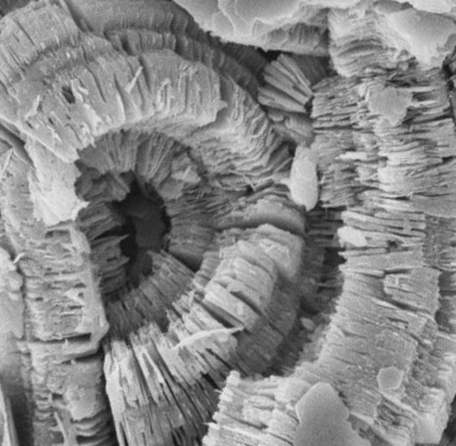
In the kaolinite crystal pictured above, it is possible to see that cross sectional information is being copied from one layer of the crystal to the next - resulting in an extruded appearance. In some crystals, information can replicated across the layers of crystals by normal crystal growth processes. Specifically, the fault structure, domain structure and cross-sectional shape can all be copied.
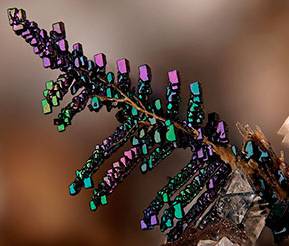
In the peowskite crystal pictured above, it is possible to see that structure is being copied in the upper most branches of the tree - with the tips of the branches being similarly oriented.
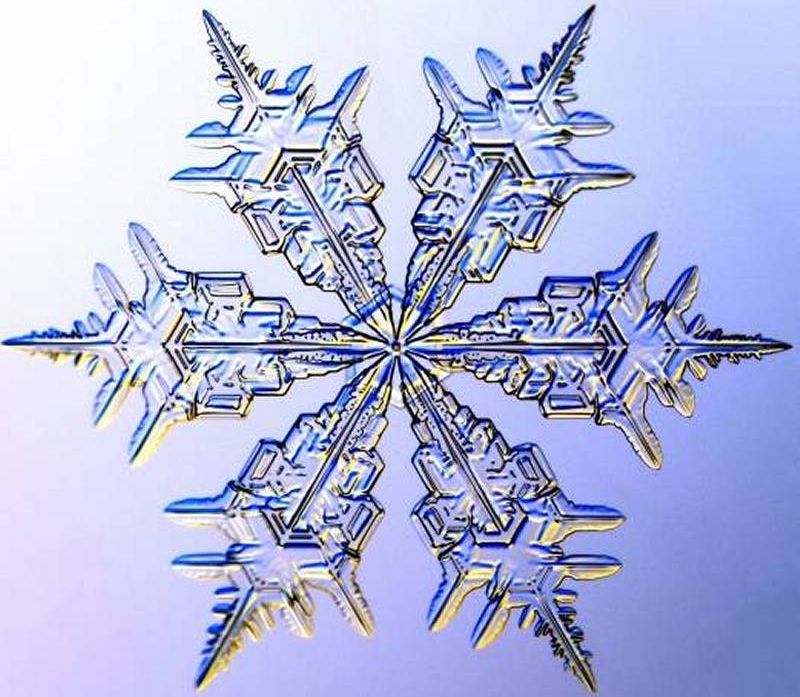
These ice crystals show a rather trivial form of copying - they share their orientation with their neighbours.
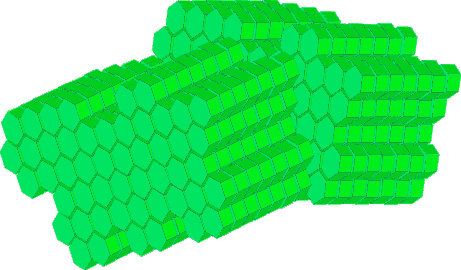
Crystals may share features through inheritance from a shared seed - or from regularities in their environment. This permafrost crystal shows some signs of both processes.
ReproductionOne reproduction scenario involves long, thin crystals. Some crystals grow long - and then may break - under the stress of having different forces act on different parts of the crystal.
When a long crystal breaks, structural information is exposed at the ends of both of the resulting crystals. It is this information that forms the heritable information of the crystals, and could act as the basis for genetic evolution.
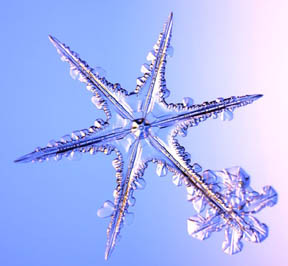
Another possibility is vegetative reproduction. A crystal may grow at its edges. Its offspring can thus grow around it. This is a kind of vegetative reproduction which need not necessarily involve physical separation. Snowflakes illustrate this manner of reproduction.
Crystal phenotypesPhysical aspects of the crystal could act as phenotypic traits - and cause selection to choose between different genotypes. Prominent targets for selection could have included brittleness, weight and speed of growth. Also, the surface grooves of the crystal could have played a role in catalysing reactions among other compounds in solution.More information about how information storage in a crystal can take place is available here. Heredity in crystals appears to be a simple, natural and common occurence. Consequently, crystals appear to be the most obvious and plausible self-replicating agents in a pre-biotic environment. Crystals grow best in a solution which is just super-saturated. On another page I describe why these conditions arise frequently. If the correct conditions are present, crystal growth enjoys a form of natural error correction. The resulting high fidelity with which crystals can transmit information between their layers makes them the most obvious and natural candidates for the first living organisms.
TakeoverIf our ancestors were crystals, how come our own genes are not crystalline?The answer to this question involves a genetic takeover. More information about genetic takeovers can be found here. The transition to cellular, nucleic acid-based life can only have happened a considerable time after the origin of life. Cells and nucleic acid represent high-technology devices that are extremely unlikely to have formed by chance - and consequently must have been constructed by an evolutionary process based on existing lifeforms.
NeglectCairns-Smith's work appears to have been neglected in modern times. Most books on the origin of life cite his work in their first chapter - point out the lack of any evidence supporting it - and then continue to other matters.For example, Paul Davis (in The Fifth Miracle) states: "It has to be said that there is very little experimental evidence to support Cairns-Smith's clay theory." (p.117). J. Maynard Smith's cursory treatment in The Major Transitions in Evolution is also fairly typical. He says: "Heredity has not been convincingly demonstrated" - which just seems like nonsense to me. I have a page devoted to why I think the neglect has happened, and what the prospects are for doing something about it - here.
CriticismA page of criticism of the theory is available.
The most plausible theory - by farCairns-Smith's theories remain by far the most plausible account of the origin of life I've ever encountered. The extent to which his ideas have been neglected appears almost tragic. I believe his work should receive much more serious attention - and expect that it will eventually become the accepted theory of life's origin.The reasons for Cairns-Smith's rejection of "protocells" and organic materials (as described in "Genetic Takeover") remains instructive reading today.
Modern significanceThe theory has very significant implications for modern attempts to create living organisms from inorganic materials. If Cairns-Smith is correct, creating primitive evolving physical systems may be fantastically simple - and indeed they may even be forming continuously all around us.Certainly - even if we ignore his theory of the origin of life - Cairns-Smith's work is of pivotal importance - because it indicates a mechanism by which genetic takeovers may occur in established living systems. As life may shortly be facing the first genetic takeover for billions of years, this theory has a special relevance today.
ReferencesFor a page of references to Cairns-Smith's theories see here.
|